
Email: hujin@chinahujin.cn
 English
 русский
 عربى
عربى
Author: HUJIN
Date: Jul 03, 2026
High Quality Vertical Band Sawing Machine: What the Cut Finish Tells You About the Build
A vertical band saw cuts curves, resaws stock, and slices through stacked material. The blade is a thin steel loop running around two wheels. When the machine is right, the cut surface comes off smooth, almost planed. When it's wrong, the blade wanders, the cut burns, or the whole frame shudders. A high quality vertical band sawing machine earns that description in the frame casting, the wheel balance, and the blade guides—not on a spec sheet.
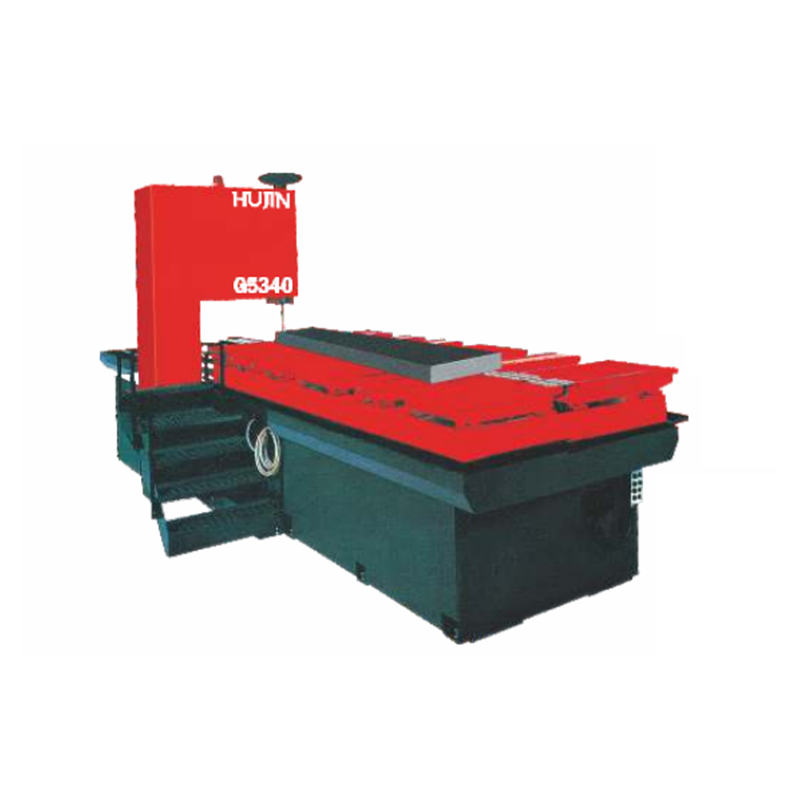
Frame and Wheel Assembly
The frame holds the two wheels in alignment under blade tension. Cast iron frames absorb vibration and stay rigid through temperature changes. Welded steel frames can be just as stiff if stress-relieved after welding. A frame that hasn't been stress-relieved will slowly twist as internal stresses release. The wheels drift out of plane. The blade tracks inconsistently and eventually jumps off. A high quality vertical band sawing machine factory stress-relieves the frame before machining the wheel mounting surfaces. Ask if they do it. The answer separates machine builders from fabricators.
The wheels themselves should be balanced, preferably dynamically. An unbalanced wheel vibrates at speed. That vibration transfers to the blade, shows up as washboard marks on the cut surface, and shortens blade life. The wheel tires—the bands the blade rides on—are rubber or polyurethane. Rubber grips well and absorbs vibration. Polyurethane lasts longer but gets hard with age. A crowned tire profile helps the blade self-centre. A flat tire relies entirely on guide adjustment to track correctly. Many high quality vertical band sawing machines use crowned tires. Check a sample machine by spinning the upper wheel by hand. It should coast smoothly with no tight spots.
Blade Guides and Tension
Blade guides support the blade above and below the table. They stop it twisting and pushing back during cutting. The guide system is typically bearing blocks, carbide pads, or cool blocks. Roller bearings guide the blade with low friction and suit high-speed resawing. Carbide pads wear slowly and provide rigid support for precision work. A high quality vertical band sawing machine factory will offer more than one guide type and be able to recommend the right one for the intended application.
The guide post adjusts up and down to match the workpiece height. A rack-and-pinion adjustment with a positive lock holds position better than a friction clamp. Check the guide post movement on a sample. It should move smoothly and lock without shifting. A post that drifts downward during a cut forces the operator to reset constantly.
Blade tension matters as much as the guides. Too little tension and the blade wanders. Too much and the blade breaks or stretches permanently. A high quality vertical band sawing machine includes a tension indicator—a gauge or a scale on the tension mechanism. Not a guess mark painted on the spring housing. A proper tension scale lets the operator repeat settings for different blade widths.
The Table and Fence
The table should be cast iron, ground flat, with a polished surface that won't rust easily. The trunnion that supports the table tilt mechanism must lock solid. A table that sags slightly when tilted and locked will throw off an angled cut. A high quality vertical band sawing machine factory grinds the table flat after the trunnion is mounted, not before. That way the flatness is referenced to the actual mounting.
The miter slot should be parallel to the blade within a few thousandths of an inch over its length. A slot cut out of parallel fights the miter gauge and burns the cut. Bring a dial indicator to a sample and run it along the slot with the indicator on the blade. The reading should hold steady. If it drifts, the table was machined off-axis.
The fence, if included, must lock parallel to the blade. A fence that deflects under hand pressure pushes the workpiece into the blade at an angle. The cut burns. The blade wanders. A rigid extrusion or a cast iron fence with two-point locking at both ends holds position. A single-point clamp fence flexes.
What to Inspect on a Floor Sample
Run the saw with no load. Listen to the wheels. A rhythmic tick is a high spot on a tire or a bad bearing. Hold a coin on edge on the table while the saw runs. It should stay upright. If it falls over, the vibration level is too high. Cut a straight line in thick hardwood or mild steel depending on the machine's purpose. Measure the cut width at the entry and exit. A difference of more than a hair means the blade is not tracking square. Check the cut surface for burn marks and washboard pattern. Both indicate guide or tension issues.
A high quality vertical band sawing machine factory that has balanced the wheels, stress-relieved the frame, dialed in the table, and specified proper guides produces a machine that cuts true out of the crate. One that hasn't produces a kit that needs hours of tuning before it makes an acceptable cut, and still drifts out of adjustment as the frame relaxes. The difference is in the cast iron and the balancing. The things you feel in the floor through your feet when the saw is running.

CONTACT
Get in touch
Related Products
Zhejiang Hujin Machine Tool Co., Ltd. is a professional manufacturer specializing in the production of "Hurein" series hydraulic presses, band saws and milling machines.
Contact Information
phone: +86-18805885558
+86-13395785558
Email: hujin@chinahujin.cn
Add: No. 300, Xingda Road, Jinxiu Industrial Park, Huzhen Town, Jinyun County, Zhejiang Province, China 321404
Mobile Site
© 2023 Zhejiang Hujin Machine Tool Co., Ltd.
Automatic Band Saw Machine Manufacturer
