
Email: hujin@chinahujin.cn
 English
 русский
 عربى
عربى
Author: HUJIN
Date: Aug 21, 2026
Automatic Rotary Horizontal Band Sawing Machine: The Saw That Cuts Angles Without Moving the Material
A long steel beam sits on the infeed conveyor. The cut requires a 45-degree miter at one end and a 30-degree bevel at the other. On a fixed saw, the operator would wrestle the beam into position twice, measuring and clamping each time. An automatic rotary horizontal band sawing machine does not move the material. It rotates the saw head. The columns, blade, and drive assembly pivot on a rotary base while the material stays clamped in place. The CNC positions the angle, the blade descends, and the cut completes. For structural steel fabrication, the rotary saw turns angle cutting from a layout and handling challenge into a programmed operation.
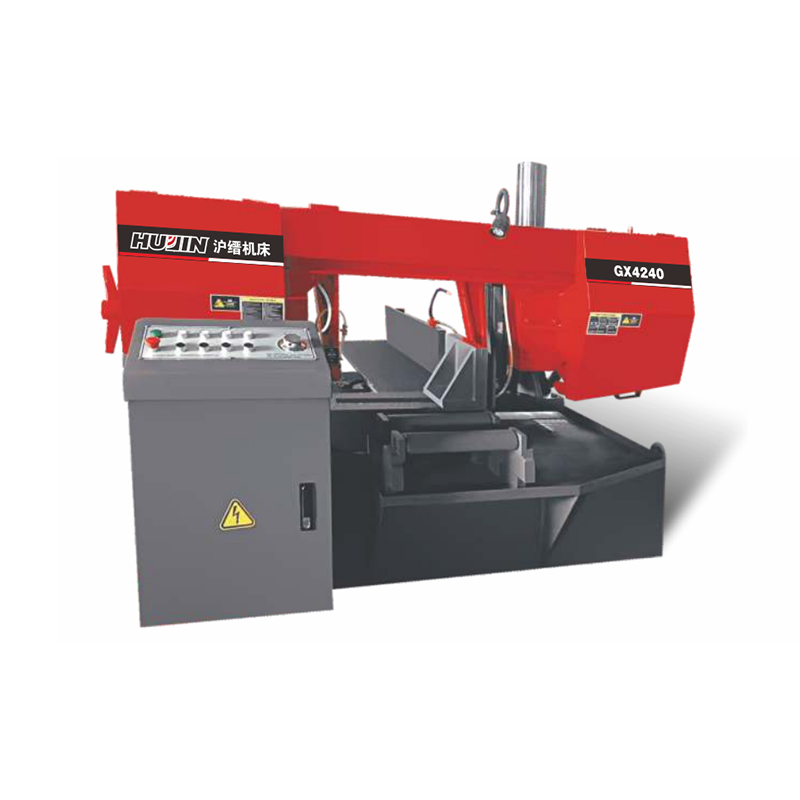
The Saw Head That Turns While the Material Stays Put
The rotary base sits between the infeed and outfeed conveyors. The saw head assembly, columns, blade guides, and drive motor, mounts on a turntable that rotates under CNC control. A servomotor positions the angle to within fractions of a degree. An automatic rotary horizontal band sawing machine cuts miters, bevels, and compound angles without the operator reclamping the material.
The rotary mechanism uses a large-diameter bearing with preloaded rollers or a precision-ground ring gear. The saw head locks into position before the cut begins. An automatic rotary horizontal band sawing machine with a rigid locking mechanism holds the set angle through the full cutting force. Angle drift during the cut produces a miter that does not fit.
The material handling system feeds the stock through the saw on powered rollers. The vise clamps the material in place. The saw head rotates to the programmed angle and executes the cut. The offcut drops onto a discharge conveyor. An automatic rotary horizontal band sawing machine with integrated material handling cuts angles on long stock without a crane or a team of operators.
CNC Control Over Every Angle and Every Cut
The operator programs the cut list: piece length, quantity, and angle for each end. The CNC positions the rotary head for the first angle, feeds the material to the programmed length, clamps, and cuts. It then rotates to the second angle if needed, feeds the next piece, and repeats. An automatic rotary horizontal band sawing machine processes an entire bundle of mixed-angle cuts from a single downloaded program.
The CNC stores job libraries. A fabrication shop cutting the same truss members every month recalls the program and runs the job without reprogramming. An automatic rotary horizontal band sawing machine with networking capability receives cut lists directly from the detailing software in the engineering office.
Angle accuracy is verified by the CNC through feedback from the rotary encoder. If the saw head position deviates from the programmed angle, the control alarms and halts the cycle. An automatic rotary horizontal band sawing machine with closed-loop angle control produces miters that fit up in the welding jig without grinding.
Blade Guidance Through the Angle
The blade runs through carbide guides that rotate with the saw head. Because the guides maintain their position relative to the blade regardless of the cutting angle, the blade support is consistent at 90 degrees, 45 degrees, or any angle in between. An automatic rotary horizontal band sawing machine with guides mounted on the rotating assembly keeps the blade perpendicular to the material through every miter cut.
The blade tension system is integrated into the rotating head. Hydraulic or mechanical tensioning adjusts automatically as the blade warms up and stretches during a production run. An automatic rotary horizontal band sawing machine with constant tension control extends blade life and maintains cut squareness.
Chip removal follows the blade path. A powered brush or coolant flush system rotates with the head so chips clear effectively at any cutting angle. An automatic rotary horizontal band sawing machine with integrated chip management prevents chips from packing into the blade teeth during angled cuts.
Here is what a production rotary saw needs:
- Rotary base with precision bearing and rigid angle lock
- CNC control with job storage and closed-loop angle feedback
- Material handling system with powered infeed and outfeed conveyors
- Blade guides and tension system integrated into the rotating head
- Chip removal that functions at all cutting angles
Trusses, Columns, and Pipe Spools
Structural steel fabricators cut beams and columns with miters for moment connections and bracing. An automatic rotary horizontal band sawing machine cuts both ends of a beam to the specified angles without the operator handling the beam between cuts.
Pipe and tube fabrication for process piping and handrails uses the rotary saw for precise bevels and miters. The saw cuts the angle and the CNC feeds the next piece. An automatic rotary horizontal band sawing machine processing a bundle of pipe spools produces finished pieces faster than a fixed saw with manual angle adjustment.
Wind tower and heavy equipment fabrication requires angled cuts on large-section plate and bar. An automatic rotary horizontal band sawing machine with the capacity to rotate under heavy saw heads handles these large workpieces while maintaining angle accuracy.
What Drifts When the Rotary Base Wears
The rotary bearing develops play and the saw head shifts during the cut. A properly preloaded bearing with a rigid lock eliminates movement. The angle encoder loses calibration and the cut angles drift from the program. An automatic rotary horizontal band sawing machine with regular calibration routines and a robust encoder holds angle accuracy over years of production.
The material feed rollers slip and the piece length varies. A CNC-controlled feed with a measuring wheel or encoder feedback maintains consistent piece lengths. An automatic rotary horizontal band sawing machine with precise material positioning cuts every piece to the same length.
An automatic rotary horizontal band sawing machine is the solution to the problem of moving heavy steel. The saw head rotates. The material stays put. Choose a manufacturer that builds the rotary base rigid, controls the angle with a CNC, and guides the blade through every miter. The steel will fit up in the welding jig without a grinder. That is what the rotary saw is for.

CONTACT
Get in touch
Related Products
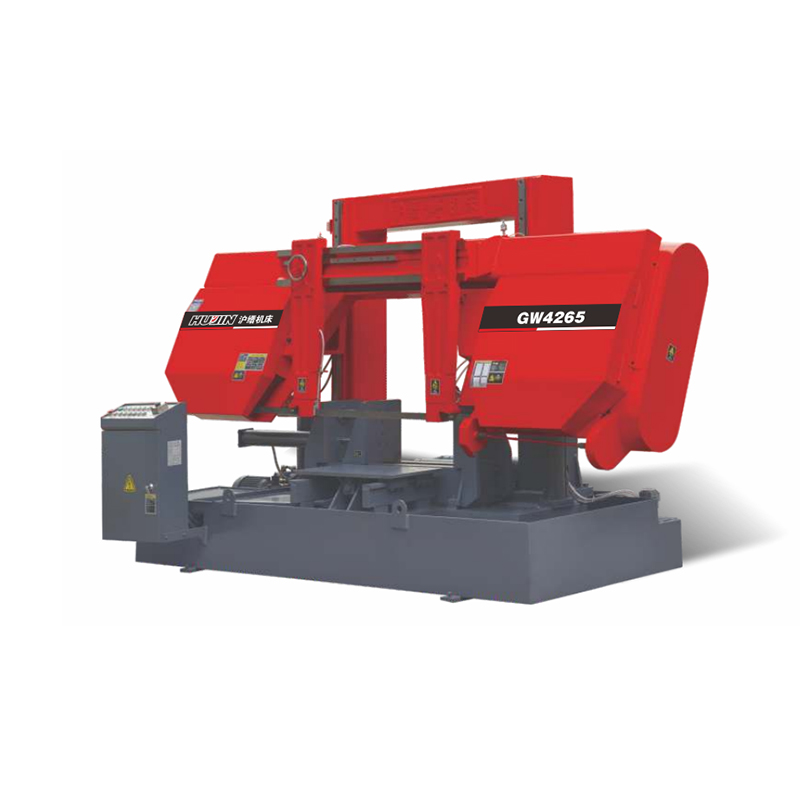
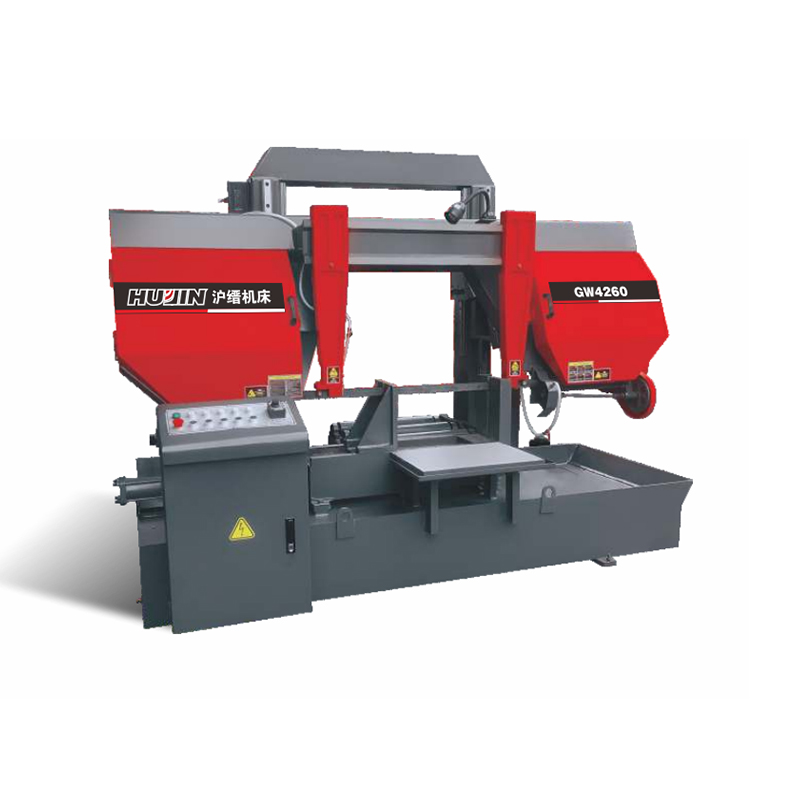
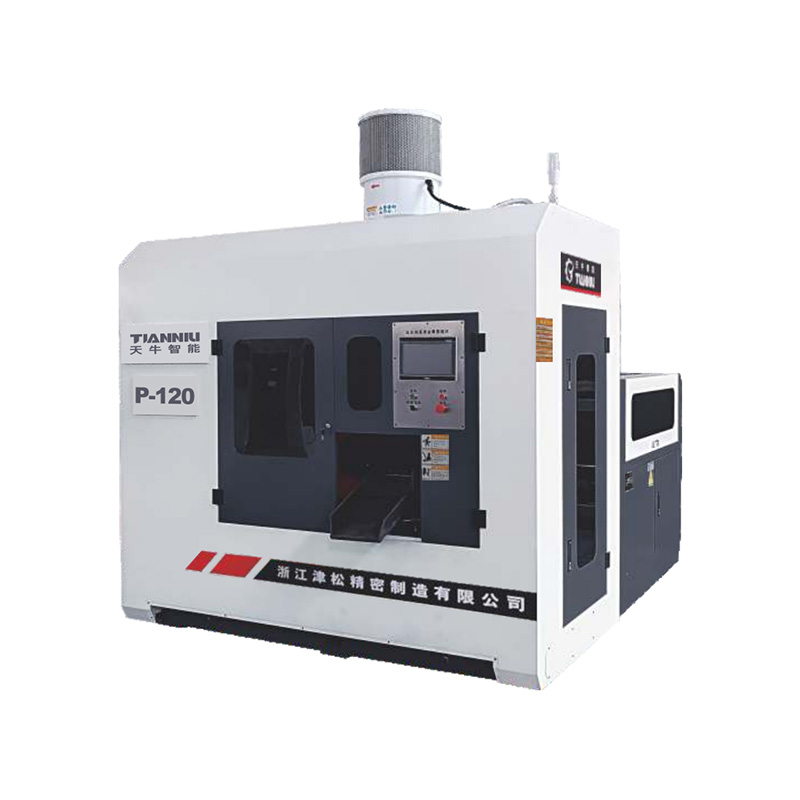
Zhejiang Hujin Machine Tool Co., Ltd. is a professional manufacturer specializing in the production of "Hurein" series hydraulic presses, band saws and milling machines.
Contact Information
phone: +86-18805885558
+86-13395785558
Email: hujin@chinahujin.cn
Add: No. 300, Xingda Road, Jinxiu Industrial Park, Huzhen Town, Jinyun County, Zhejiang Province, China 321404
Mobile Site
© 2023 Zhejiang Hujin Machine Tool Co., Ltd.
Automatic Band Saw Machine Manufacturer
